Two chambers of parliament, 45 constituencies, two votes. The proposal gives each region a voice while keeping representation fair across Slovakia.
System 2027 would establish a two-chamber parliament and bring politics closer to the regions while giving votes equal weight. Slovakia would be divided into 45 geographically contiguous constituencies. The same boundaries would be used to elect local members of the National Council of the Slovak Republic and members of the Senate.
The lower house would normally have 111 members. Voters would directly elect a local representative in each of the 45 constituencies. The remaining seats would be allocated nationally to keep representation proportional and give votes equal weight. The Senate would have 45 members, one per constituency. Senators would serve six-year terms, with one third of the seats up for election every two years.
Each of the 45 constituencies would elect its own MP, so voters would know who represents their region and whom to hold to account.
Compensatory seats would bring the overall balance of seats into line with the second votes cast nationwide. The aim is for every vote to count.
The 45 senators would serve staggered six-year terms. Renewing one third of the Senate at a time would provide continuity and oversight.
You would vote for one candidate in your single-member constituency. In each of the 45 constituencies, the candidate with the most votes would win.
You would vote for a political party. These votes would be counted nationwide and used to adjust the balance of seats in the 111-member lower house.
You would elect a senator using the same map of 45 constituencies. One third of the 45 Senate seats would be up for election every two years.
Your first vote helps choose who represents your constituency. Your second vote helps determine your party’s share of seats in the lower house as a whole.
Minimum share of the national party vote ordinarily needed to qualify for seats
Maximum threshold for a coalition, regardless of how many parties it includes
111 seats as standard, with room to expand to a maximum of 125
Winning one constituency seat qualifies a party for the allocation of further seats
Maximum permitted deviation from the target constituency population
An independent commission would review the boundaries after each census
FSF offers this proposal as a basis for expert and public discussion during 2026.
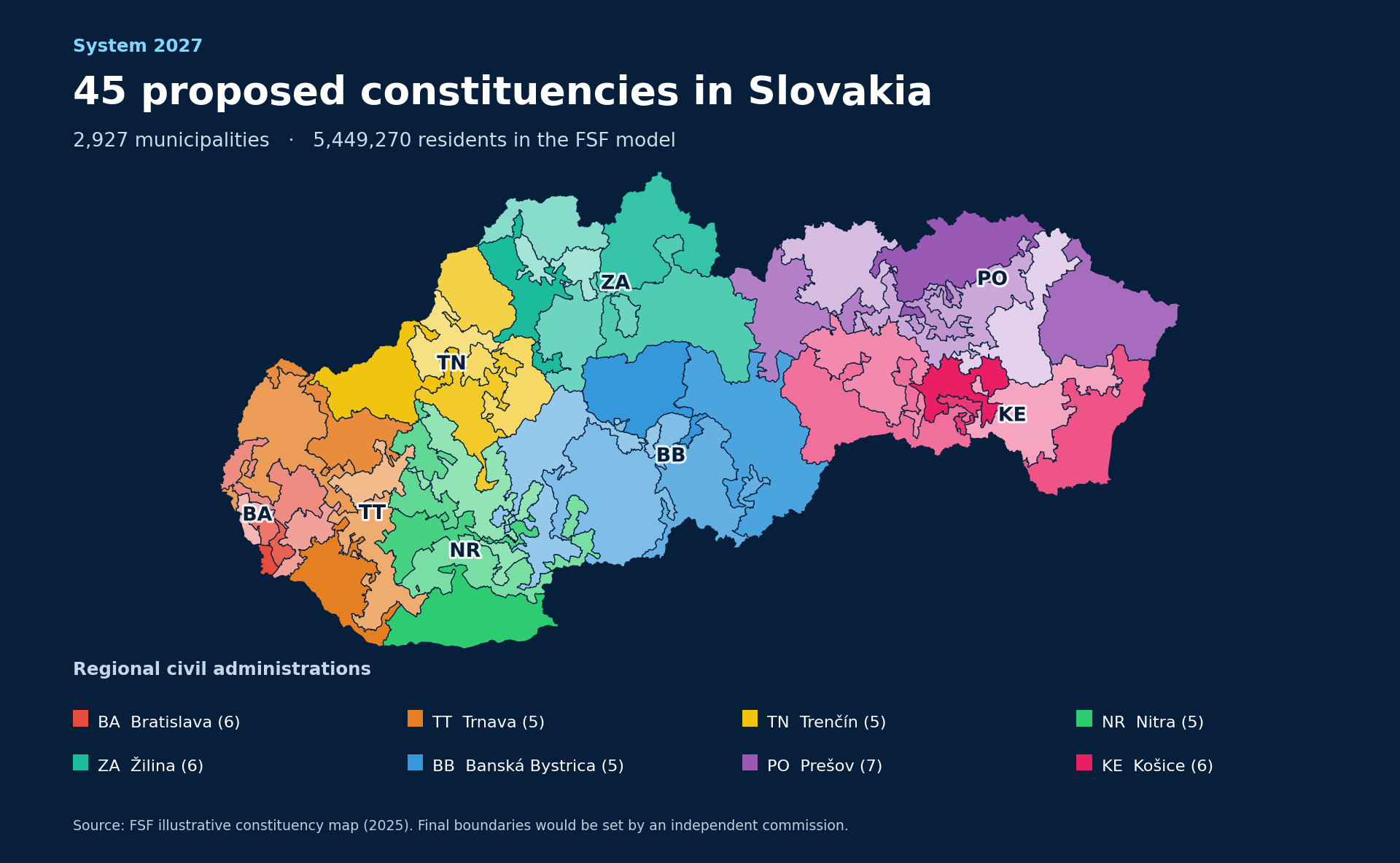
FSF’s illustrative map covers all 2,927 municipalities in Slovakia. All 45 constituencies are geographically contiguous. Most are within 10% of the target population and all are within 12%. Average regional alignment is 85.7%.
Illustrative map of 45 constituencies prepared by FSF for discussion
The map shows how the proposal could work and provides a starting point for discussing constituency boundaries. FSF’s suggested boundaries are provisional and carry no legal force. The independent Electoral and Boundaries Commission of the Slovak Republic would draw the final boundaries, giving equal weight to votes and respecting geographical contiguity and communities of interest in line with the standards of the Council of Europe’s Venice Commission.
The Senate’s role would be to allow time for reflection, give legislation a second reading and strengthen constitutional safeguards. Responsibility for governing would remain with the government.
The Senate could send ordinary legislation back for reconsideration. The National Council could override its veto with an absolute majority of 56 votes out of 111.
Both chambers would have to agree on constitutional and electoral legislation. This would prevent either chamber from rewriting the rules on its own.
The Senate would have no say over the budget, taxation or votes of confidence in the government. This would allow the government to carry on its work.